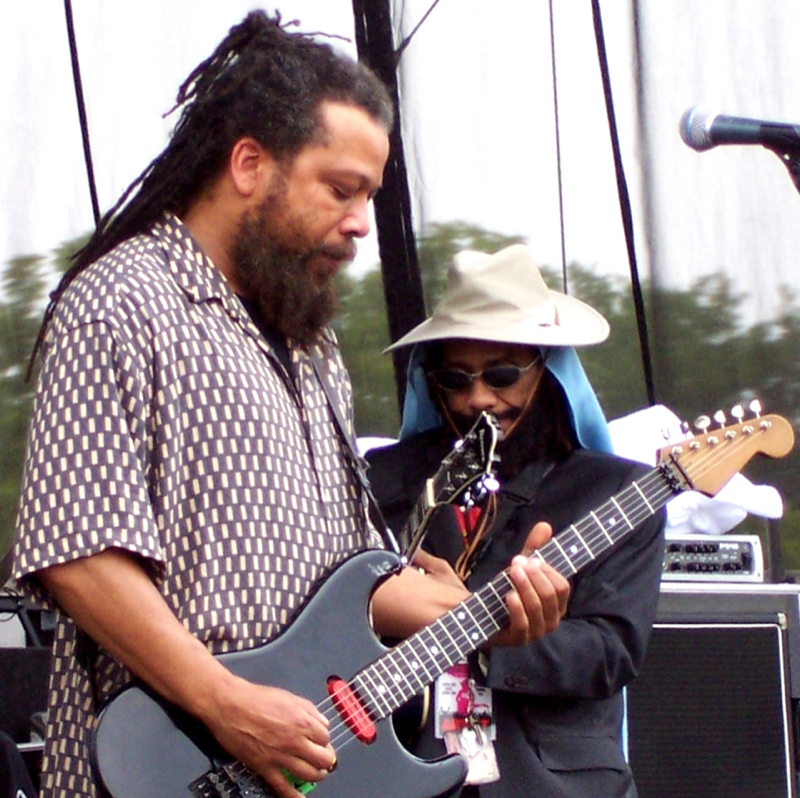
DC Hardcore
How a handful of teenagers in the nation's capital ignited the straight edge movement and redefined American punk
The Scene
Georgetown University's student radio station WGTB ran with minimal oversight in the early 1970s, broadcasting cultural radicalism to a city still reeling from the 1960s. Dupont Circle evolved into an increasingly diverse, LGBT-inclusive community. Adams Morgan simmered with social restlessness. When the Ramones rolled through in 1976, something shifted. By late 1976, the city's first punk bands—the Slickee Boys, Overkill, the Look—started claiming basement spaces and dive bars. Skip Groff's Limp Records pressed the earliest DC punk singles, including the compilation :30 Over Washington. Don Zientara founded Inner Ear Studios, a cramped space that would become the sonic laboratory for the scene to come.
The Atlantis, tucked in the rear room of the Atlantic Building at 930 F Street NW, hosted its first punk show on January 27, 1978: the Slickee Boys, Urban Verbs, and White Boy. The venue died quickly, shuttering by early 1979, but the space reopened on May 31, 1980 as the 9:30 Club—a name that would become synonymous with DC punk. By then, a new generation was forming bands in high school basements. Ian MacKaye and Jeff Nelson played in the Teen Idles while attending Wilson High School, drawing crowds of around a hundred—massive by local standards, second only to Bad Brains.
The venue died quickly, shuttering by early 1979, but the space reopened on May 31, 1980 as the 9:30 Club—a name that would become synonymous with DC punk.
Steve Hansgen entered the scene through his cousin Mark Noone, lead singer of the Slickee Boys. “I was out in suburban Virginia getting into this kind of music and he was feeding me information about this really cool scene in downtown D.C. where there were kids my age playing Punk Rock in clubs,” Hansgen recalled. “It was only twelve miles away from me, but it might as well been two hundred miles away.” He started attending shows sporadically in summer 1980, roadying for the Slickee Boys. That fall, he was completely indoctrinated. A punk rocker. Right around that time, the Teen Idles broke up and the DC punk scene became hardcore.
When the Teen Idles broke up, MacKaye and Nelson used their band's modest earnings—around $600—to start Dischord Records. They pressed 1,000 copies of the Teen Idles' Minor Disturbance EP, then sat down and hand-cut, folded, and glued every single record sleeve themselves. The DIY approach wasn't ideology yet—it was necessity. They had no money, no distribution, no industry contacts. Eventually, they'd hand-crafted 10,000 copies of that first release. Dischord Records was born not from a business plan but from two teenagers figuring out how to get their friends' music into fans' hands.
Key Players
Ian MacKaye stands as the scene's moral and creative center. Born April 16, 1962, he grew up in Glover Park, son of a Washington Post religion writer who rode in JFK's motorcade the day the president was assassinated. MacKaye discovered punk in November 1978 via borrowed British records—Never Mind the Bollocks, Generation X—and attended his first show three months later when The Cramps played Georgetown. He formed the Teen Idles with drummer Jeff Nelson, then Minor Threat in December 1980, writing “Straight Edge” as a personal declaration of sobriety, not a manifesto. The song became a movement anyway, spawning a subculture MacKaye never intended. “Well, basically how it originated was that Jeff, our drummer, and I were in a band called the Teen Idles,” MacKaye explained to Maximum Rocknroll, “and we were at that time trying to get away from a really corrupted music, you know, basically your heavy metal bands who were into heroin, cocaine.” After Minor Threat dissolved in 1983—creative tensions over U2's influence, of all things—he fronted Embrace, dabbled in industrial with Pailhead, then co-founded Fugazi in 1987. MacKaye co-owns Dischord Records, produces albums for Bikini Kill and Rollins Band, and remains punk's most uncompromising voice, refusing major labels, high ticket prices, and corporate media.
Jeff Nelson learned to play drums by listening to records. No lessons. Just put on “Pure Mania” by The Vibrators and played along. At seventeen, in 1979, he saw a listing for a drumset for $85. He didn't have his driver's license yet, so his friend Nancy drove him in her parents' station wagon to pick it up. That kit would power the Teen Idles and Minor Threat. Nelson's drumming hit like a metronome set to panic, and his business partnership with MacKaye at Dischord proved equally precise. He sometimes wore gloves while playing and set his cymbals unusually high, a distinctive visual signature frozen in dozens of photos from the era.
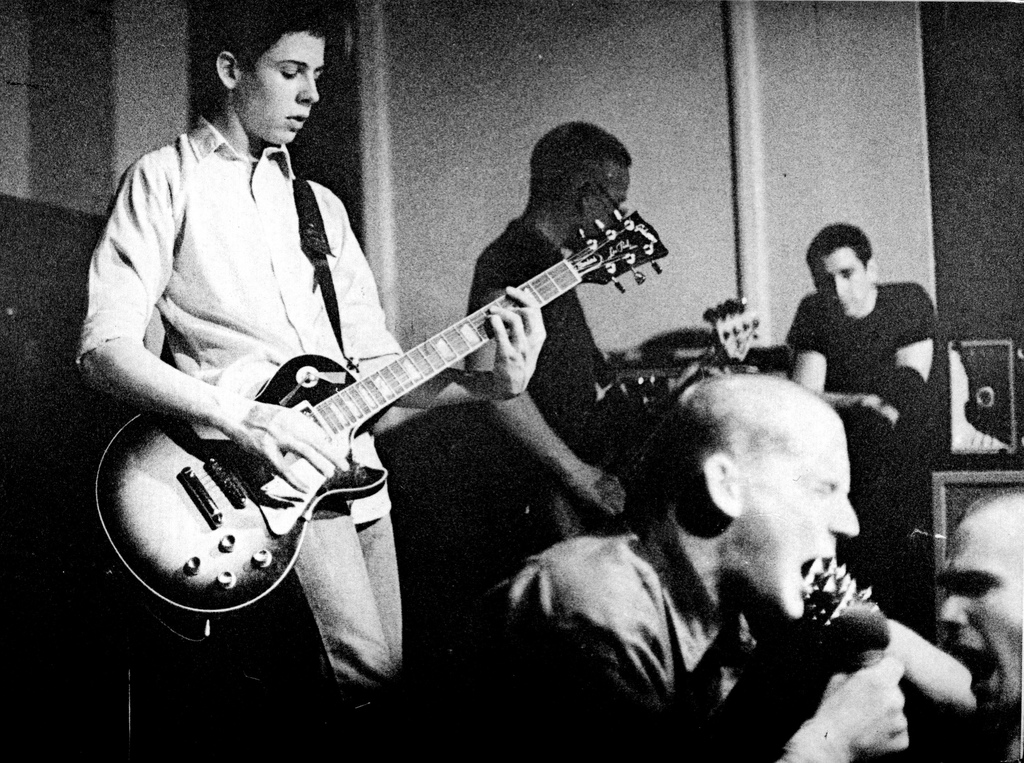
Minor Threat at The Wilson Center, April 1981. Lyle Preslar, Brian Baker, Ian MacKaye, Jeff Nelson. The band that named straight edge and rewrote the rules of punk.
Guy Picciotto entered Fugazi as a backup vocalist in 1988, fresh from the wreckage of Rites of Spring and Happy Go Licky. He'd grown up steeped in the DC scene, watching MacKaye and Nelson build something from nothing. When MacKaye invited him to join, Picciotto accepted, eventually picking up a Rickenbacker guitar to carve out high, scratchy countermelodies against MacKaye's chunky low-end riffs. Picciotto's presence transformed Fugazi from MacKaye's solo project into a true collaborative unit. His emotionally raw performances with Rites of Spring—pacing the stage, voice cracking, sweat-soaked—had already challenged hardcore's macho posturing during Revolution Summer.
Lyle Preslar played guitar in Minor Threat, crafting the sharp, trebly riffs that cut through Jeff Nelson's drumming. By 1983, Preslar and bassist Brian Baker had become obsessed with U2's The Joshua Tree, envisioning a more melodic, expansive sound for the band. MacKaye wasn't interested. The tension fractured the band from within. “Ian was right, and we were wrong,” Baker later reflected. “What Ian was doing was not just a band—he was building a community. He was so far ahead of his time, thinking about Dischord and this reciprocating relationship with other artists. But I was like, 'I want to play bigger shows, I want to tour more. Minor Threat is a great little punk band, but have you heard the Boy album?' I was dumb! And he wasn't.”
That kit would power the Teen Idles and Minor Threat.
Brendan Canty drummed for Rites of Spring before joining Fugazi, where his playing anchored the band's stop-start dynamics and rhythmic experimentation. Along with Picciotto, Canty became deeply involved in recording, helping run Pirate House studios. Joe Lally provided Fugazi's bass, inspired by reggae and post-punk, moving in conversation with Canty's drums rather than simply locking into root notes. Together with MacKaye and Picciotto, they formed one of the most uncompromising bands in American rock.
Defining the Sound
DC hardcore was speed and economy weaponized. Minor Threat's songs rarely exceeded ninety seconds, each one a compressed blast of drums and guitars raced to their absolute limit. MacKaye's vocals—barked, shouted, sometimes shrieked—carried teenage rage filtered through moral clarity. Nelson's drumming hit with military precision. Preslar's guitar carved out sharp, trebly riffs that cut through the mix. The goal wasn't virtuosity; it was catharsis through sheer energy expenditure. Songs like “Straight Edge” and “Out of Step” stripped rock music to its skeletal essentials: verse, chorus, bridge, done. No solos, no showboating, no wasted space. The production—captured at Inner Ear with minimal overdubs—was raw but not lo-fi, emphasizing clarity over grit. You could hear every instrument, every syllable, every snare hit.
Bad Brains complicated the template, injecting reggae and funk into hardcore's rigid structure. Their influence pushed DC bands toward rhythmic experimentation. Fugazi took this idea and ran with it, fusing punk aggression with dub basslines, stop-start dynamics, and dissonant guitar interplay. MacKaye played chunky, low-end chords on a Telecaster or SG, while Picciotto countered with a Rickenbacker's scratchy single-coil bite. The two guitars rarely functioned as “lead” and “rhythm”—instead, they interlocked, creating tension through unexpected chord voicings and syncopated rhythms.
You could hear every instrument, every syllable, every snare hit.
“The two guitars are both sort of up-front,” Picciotto explained to Tape Op. “They're working in tandem but they're also working against each other.” Lally's bass, inspired by reggae and post-punk, moved in conversation with Canty's drums rather than simply locking into root notes. The rhythm section created space for the guitars to clash and resolve. Fugazi invested in recording equipment early—a Soundcraft board, an 8-track reel-to-reel, some mics—setting it up in their practice space. When it kept sitting unused, Canty started offering it to neighborhood bands. “In D.C., things have kind of changed where there really wasn't a cheap recording facility like Inner Ear was in the early days,” he told Tape Op. “Things have gotten more expensive, so for a lot of the young bands that didn't really have any money and were just starting out, we were like, 'Well, we've got this equipment and we'll let you use it.'” What started as an 8-track in a group house eventually became Pirate Studios, bumped up to 16-track when Juan Carrera took over.
By the time Fugazi recorded End Hits, they'd become intimately familiar with the studio as an instrument. The band's sound evolved from hardcore's rigid economy into something more elastic and experimental, proving a band could grow over ten years without becoming a bloated parody of itself. The DC sound—born in basements, refined at Inner Ear, disseminated through Dischord—established a template that hundreds of bands would follow: raw but clear, aggressive but intelligent, fast but deliberate.
Stories
Minor Threat's first show in December 1980 drew fifty people to a basement, opening for Bad Brains, The Untouchables, Black Market Baby, and S.O.A. The band had no recordings yet, no reputation beyond the Teen Idles' modest following. MacKaye commanded the room anyway, pacing, shouting, channeling Joe Cocker's unhinged Woodstock performance. Jeff Nelson pounded the drums with military precision. By the end of the night, Minor Threat had staked their claim. Within months, they pressed their first 7-inch, Minor Threat, on Dischord. MacKaye, Nelson, and their bandmates cut, folded, and glued the packaging themselves to keep costs down. The DIY approach wasn't ideology yet—it was necessity. They had no money, no distribution, no industry contacts. What they had was urgency.
When Minor Threat toured the country in 1982, they encountered regional variations of punk that felt like entirely different species. “In Boston they dance like penguins,” MacKaye told Maximum Rocknroll. “They all punch dance. They shadowbox. They walk around real fast.” In Detroit, people couldn't dance because the venue was smaller than the Tool & Die in San Francisco—a room packed with close to 250 people pushing against each other. In San Francisco, MacKaye felt challenged. The city had a reputation for tackling out-of-town bands, a local ritual. “I felt people were challenging me because I was from Washington, which has this apparently incredible reputation, or whatever,” he said. “And I am talking basically in the fighting sense—who is tougher than who. That's what I felt was going on when I was tackled at a show.” The territorial nature of American hardcore was simultaneously exciting and dangerous, creating tight-knit local scenes while breeding gang warfare mentality in some cities.
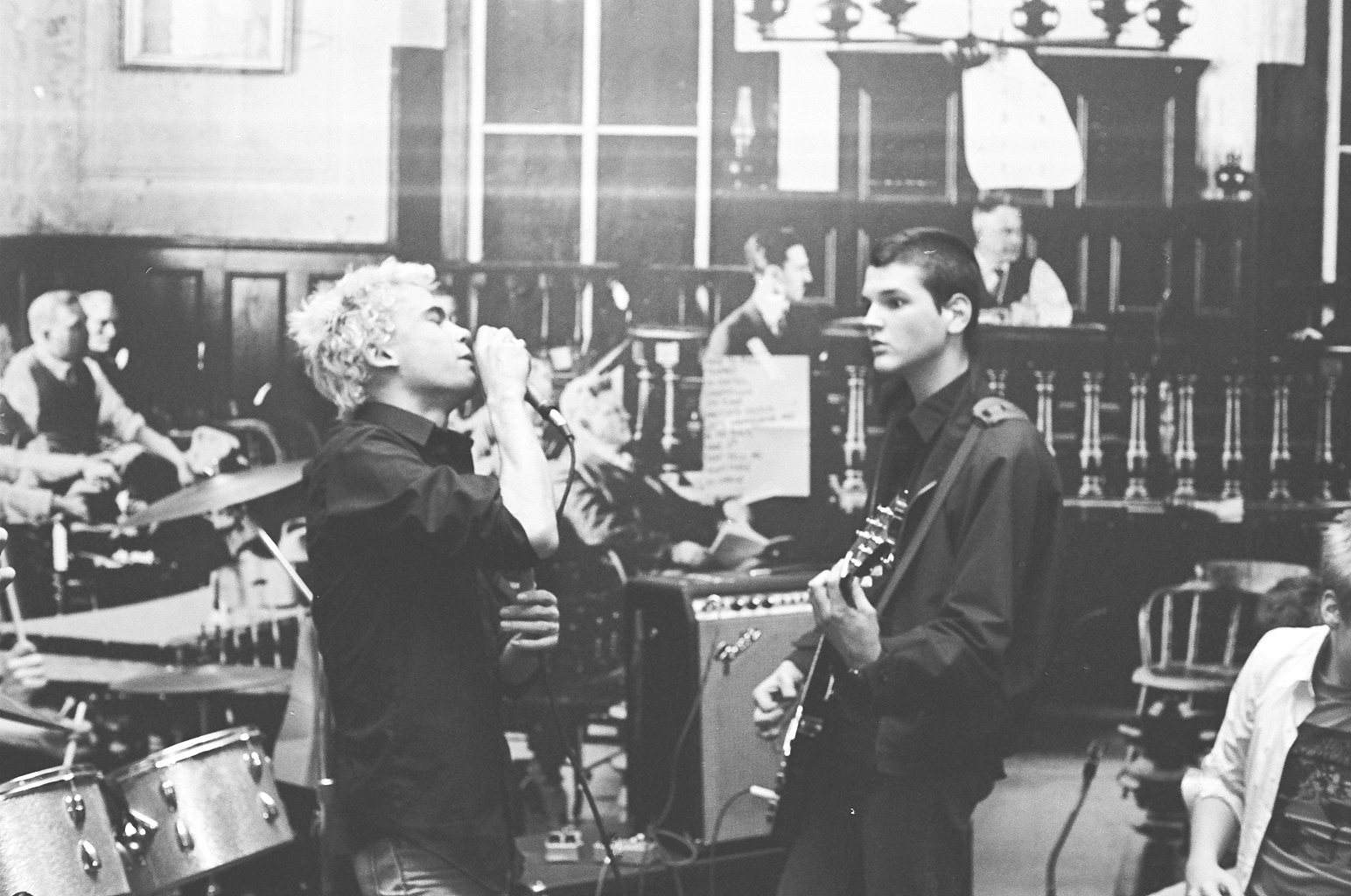
The Faith at The Chancery. One of the original Dischord bands, sharing a split LP with Void that became a blueprint for DC's sound.
In September 1993, Fugazi sold out three consecutive nights at New York's Roseland Ballroom. Backstage, Ahmet Ertegun—legendary founder of Atlantic Records, the man who signed Led Zeppelin and the Rolling Stones—made his pitch. He offered Fugazi “anything you want”: their own subsidiary label, complete creative control, over $10 million just to sign. The band listened politely, then declined. “No amount of money is worth losing control of our music,” MacKaye later explained. The decision baffled the industry. Fugazi were at their commercial peak, regularly selling out 1,000+ capacity venues, moving hundreds of thousands of records without major label support. Lollapalooza organizers also tried recruiting them. The band refused every offer, staying true to the principles they'd built Dischord to protect. They'd rather play community centers for $5 than compromise their independence for millions.
By 1985, DC hardcore had devolved into a caricature of itself. Violence dominated shows, nihilism replaced the scene's original idealism, and many of the older punks found themselves repelled by what their hometown had become. Amy Pickering, who worked at Dischord Records and played in Fire Party, proposed a solution: a conscious “re-birthing” of the scene. She brought the idea to a circle of musicians who were equally exhausted with the status quo. The movement that emerged was dubbed Revolution Summer, and it challenged everything hardcore had become. Bands like Rites of Spring, Embrace, and Dag Nasty rejected macho posturing in favor of vulnerability and introspection. Guy Picciotto would pace the stage during Rites of Spring shows, voice cracking, sweat-soaked, mining emotional depths that hardcore had previously deemed off-limits. MacKaye's Embrace slowed the tempo and created space for melody. The violence didn't disappear overnight, but Revolution Summer proved that DC's scene could evolve beyond the limitations of hardcore orthodoxy.
Legacy and Influence
DC hardcore's influence radiated outward, reshaping American punk and alternative rock. Fugazi's DIY model inspired countless bands to reject major labels and retain creative control. Nirvana cited them as a key influence; Kurt Cobain wore “Fugazi” scrawled on his shoes. Eddie Vedder called seeing Fugazi live “a life-changing experience.” Jimmy Eat World's Jim Adkins said MacKaye and Picciotto's guitar interplay “made me more open to ideas behind guitar playing, as opposed to technical difficulty.” At the Drive-In, Refused, Quicksand, Thrice, Thursday, and Cursive all acknowledged Fugazi's impact. Post-hardcore as a genre wouldn't exist without DC's experiments in the mid-'80s.
Rites of Spring's emotional intensity seeded emo, though the band rejected the label. Nation of Ulysses inspired riot grrrl bands like Bikini Kill, whom MacKaye later produced. Simple Machines Records modeled itself on Dischord's ethics. The straight edge movement, accidentally ignited by MacKaye's song, spread globally, influencing punk scenes from Boston to Brazil. Youth crew hardcore in the late '80s—bands like Youth of Today and Gorilla Biscuits—carried the torch, though MacKaye distanced himself from the movement's more dogmatic adherents. “I wrote a song about my personal choice,” he said. “I didn't start a movement.” Yet straight edge endured, evolving into a lifestyle philosophy that extended to vegetarianism and animal rights activism. MacKaye himself became vegan, viewing it as a logical extension of his commitment to conscious living.
Nation of Ulysses inspired riot grrrl bands like Bikini Kill, whom MacKaye later produced.
The territorial music scenes that Minor Threat encountered on tour became the norm across America. “It's the first time in the U.S. that this has happened to rock music to a great extent,” Brian Baker told Maximum Rocknroll in 1982. “I think it's great, what is happening across the country right now. This territorial kind of music scene. As opposed to this nationwide music we've been living with all these years.” That fragmentation created the conditions for hundreds of regional hardcore scenes to flourish, each with its own character, each feeding off DC's example of self-sufficiency and moral conviction. When Fugazi's In on the Kill Taker charted on Billboard in 1993, receiving critical praise from Spin, Time, and Rolling Stone, it proved that uncompromising DIY ethics could reach mass audiences without sacrificing principles. The lesson wasn't lost on the generation of bands that followed.
New York Hardcore
DC hardcore's DIY ethos and straight edge philosophy influenced NYHC bands like Youth of Today and Gorilla Biscuits in the youth crew movement.
California Hardcore
Black Flag and Bad Religion shared stages with DC bands; MacKaye cited California hardcore as a major influence on Minor Threat's sound.
Emo / Midwest Emo
Rites of Spring and Embrace's emotional intensity directly influenced Cap'n Jazz, Braid, and the broader emo movement of the '90s.
Nation of Ulysses inspired Bikini Kill and other riot grrrl bands; MacKaye produced Bikini Kill's recordings at Dischord.
Grunge / Alternative Rock
Nirvana, Pearl Jam, and Soundgarden cited Fugazi as influences; DC hardcore's DIY model provided a blueprint for '90s alt-rock independence.