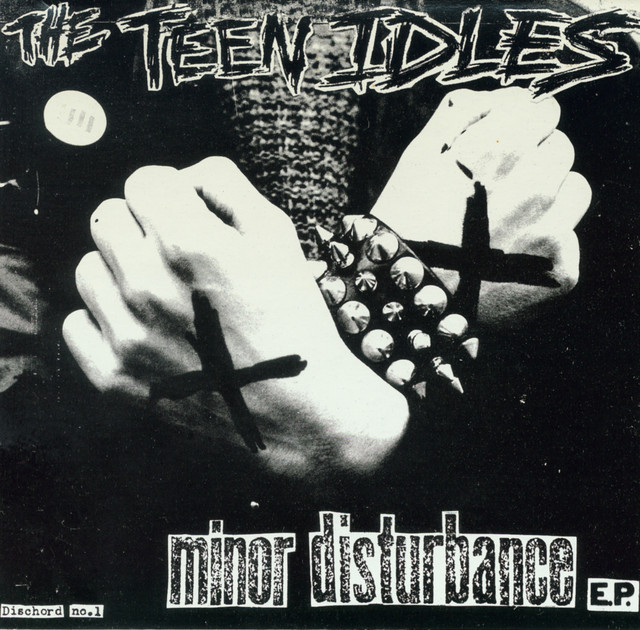
At a glance
- Artist
- Teen Idles
- Released
- December 1980
- Label
- Dischord Records
- Catalogue number
- DIS001
- Format
- 7″ Vinyl
- Country
- US
- Tracks
- 8, 9:37
In the issue
Dischord's first release shows the DIY necessity that started it all, two teenagers hand-assembling 10,000 copies.
Dischord Records' first release, hand-assembled by MacKaye and Nelson, who personally cut, folded, and glued all 10,000 copies across several pressings. The DIY method wasn't a statement of ideology so much as necessity: two teenagers with $600, figuring out the only way they knew to get their friends' music into people's hands.
How it was made
Teen Idles recorded Minor Disturbance at Inner Ear Studios in Arlington, Virginia, in March 1980, shortly before the band broke up. The session cost $600—money scraped together from VFW halls, community centers, and anywhere else that would book them. Don Zientara, who would become DC hardcore's most important engineer, tracked all eight songs in a single day. The record caught the Teen Idles at their rawest: Ian MacKaye's vocals furious but unrefined, the band's attack pure teenage adrenaline without the discipline Minor Threat would develop later. No label would press something this uncompromising. MacKaye and Jeff Nelson had to figure out distribution themselves. They created Dischord Records specifically to release Minor Disturbance, hand-numbering the first copies and pressing an initial run of 1,000 sold through mail order and at local shows. The DIY approach wasn't ideological at first. It was practical necessity that hardened into conviction.
Listen
Track list
- A1Teen Idles0:44
- A2Sneakers1:28
- A3Get Up and Go0:52
- A4Deadhead1:21
- B1Fleeting Fury1:20
- B2Fiorucci Nightmare0:44
- B3Getting in My Way1:04
- B4Too Young to Rock2:04
The label
Founded with roughly $600 in Teen Idles earnings, Dischord released the scene's foundational records, starting with the hand-assembled Minor Disturbance EP and continuing through Minor Threat, Flex Your Head, and Fugazi's catalog. Its DIY methods, cheap ticket and record prices, and refusal to sign with major labels set the ethical template that DC hardcore and its later offshoots operated by.