German Krautrock
How West German youth rejected their Nazi past and invented the future of electronic music in converted castles and self-built studios
The Scene
The question wasn't what Germans wanted to sound like. It was whether they had any right to make popular music at all. While British and American kids in the mid-1960s inherited rock and roll as birthright, young Germans stared into a cultural vacuum. “When we started it was like, shock, silence,” Ralf Hütter told Jon Savage in 1991. “Where do we stand? Nothing. Classical music was of the 19th century, but in the 20th century, nothing. We had no father figures, no continuous tradition of entertainment.”
The first stirrings came in 1967 when art student Edgar Froese formed Tangerine Dream in West Berlin, inspired by mishearing “tangerine trees and marmalade skies” from the Beatles' “Lucy in the Sky with Diamonds.” That same year, at the Robert Schumann Hochschule in Düsseldorf, two students of avant-garde composer Karlheinz Stockhausen—Holger Czukay and Irmin Schmidt—began discussing possibilities. How to merge academic electronic music with rock's visceral energy. These were proto-movements: art students and conservatory dropouts creating in isolation, before anyone called it Krautrock.
How to merge academic electronic music with rock's visceral energy.
By 1968, revolutionary student protests sweeping Europe gave these musical experiments political urgency. “Through the 50s and 60s everything was Americanised, directed towards consumer behaviour,” Hütter explained. “So, we were part of this '68 movement, where suddenly there were possibilities.” As Dieter Moebius of Cluster later put it: “we were a lot of the times on the streets instead of studying. As young people we were not very proud to be German [...] we were all tired of listening to bad German music and imitations of American music. Something had to happen.” In Cologne, Can formed around the ex-Stockhausen students, recording their first sessions in Schloss Nörvenich, a converted castle outside the city. In Berlin, Conrad Schnitzler and Klaus Schulze were building synthesizers by hand. In Düsseldorf, Ralf Hütter and Florian Schneider met “accidentally” at the conservatory, as Hütter put it, “there were no other people around there at the time.”
The infrastructure barely existed. German state radio wouldn't play rock and roll. Hütter remembered tuning into American Forces Network transmissions from Stuttgart as a teenager, hearing Little Richard's “Tutti Fruitti” for the first time. “I remember being very excited when The Beatles came along, and annoyed with my parents because they wouldn't let me go to one of their concerts.” These bands built their own studios because commercial facilities didn't understand what they wanted. Can converted a cinema in Cologne. Kraftwerk established Kling Klang in Düsseldorf—the German word for sound is 'klang', 'kling' is the verb. Tangerine Dream worked in a Berlin space where temperature fluctuations became part of the recording process. They were establishing, as Hütter said, “some form of industrial German sound.”
Key Players
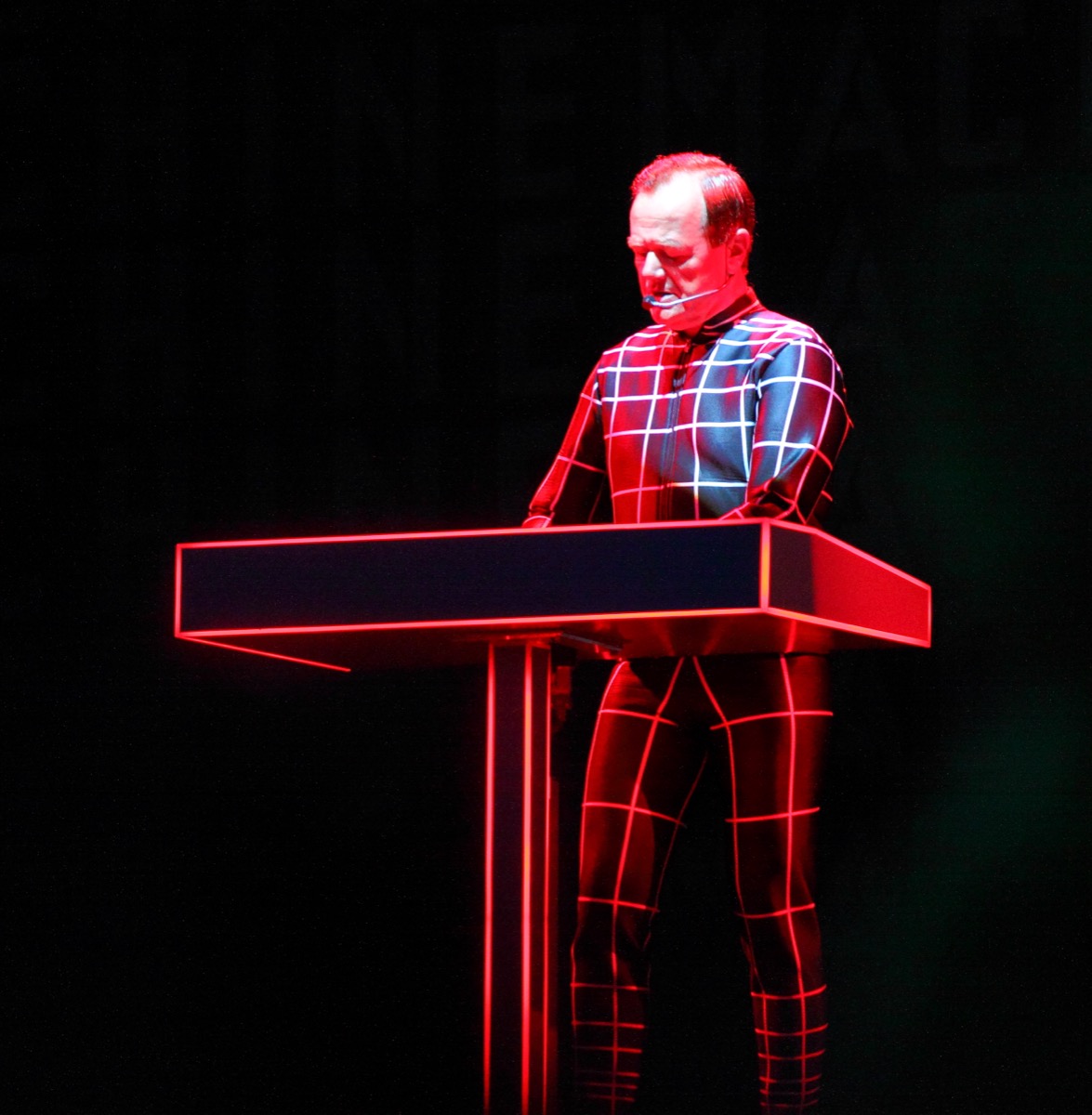
Ralf Hütter and Florian Schneider formed Kraftwerk in 1970 after meeting at the Düsseldorf conservatory, where they'd both been part of the Organisation quintet. Hütter, the pragmatist on keyboards and organ, and Schneider, the sonic tinkerer on flute and electronics, were inspired by seeing Gilbert and George at an art exhibition in Düsseldorf—“two men wearing suits and ties, claiming to bring art into everyday life.” They decided to reverse the equation: bring everyday life into art. Their Kling Klang Studio became as much an instrument as a space. The first Minimoog Hütter bought “cost as much as my Volkswagen,” he recalled. Equipment was “both very simplistic and expensive.” They worked with echo chambers and different types of tape machine, cutting and splicing with razor blades. “To edit one piece of music on to another, we had to cut the tape with a razor blade,” Hütter explained. Their 1974 hiring of Conny Plank to engineer Autobahn proved decisive, though they'd later reduce their dependence on outside producers. By the mid-1970s, with Wolfgang Flür and Karl Bartos completing the quartet, they'd evolved from krautrock experimentalists into something more streamlined and conceptual—“robot pop,” as they called it—that would blueprint electronic dance music for decades.
Holger Czukay and Irmin Schmidt were Can's intellectual anchors, both having studied under Stockhausen and absorbed his ideas about sound as material rather than melody. Czukay, who'd “taken up bass guitar almost by default,” became Can's sonic architect, editing hours of improvisation into coherent compositions using techniques he'd learned from his teacher. Schmidt, classically trained on piano, brought an understanding of how to build tension without traditional chord progressions. When they recruited American sculptor Malcolm Mooney in 1968, they found a vocalist who treated words as raw sound rather than meaning. After Mooney's departure for psychiatric treatment in 1970, they found Damo Suzuki—born Kenji Suzuki—busking on a Munich street the afternoon of a scheduled concert. They asked if he'd like to perform that night. He said yes. For the next three years, Suzuki sang wordless glossolalia, fragments of English, German, Japanese, all delivered with ecstatic intensity. Jaki Liebezeit, Can's drummer, provided the metronomic grooves that locked the chaos into hypnotic forward motion. Michael Karoli's guitar work, processed through effects and treated as texture rather than lead instrument, completed the sound.
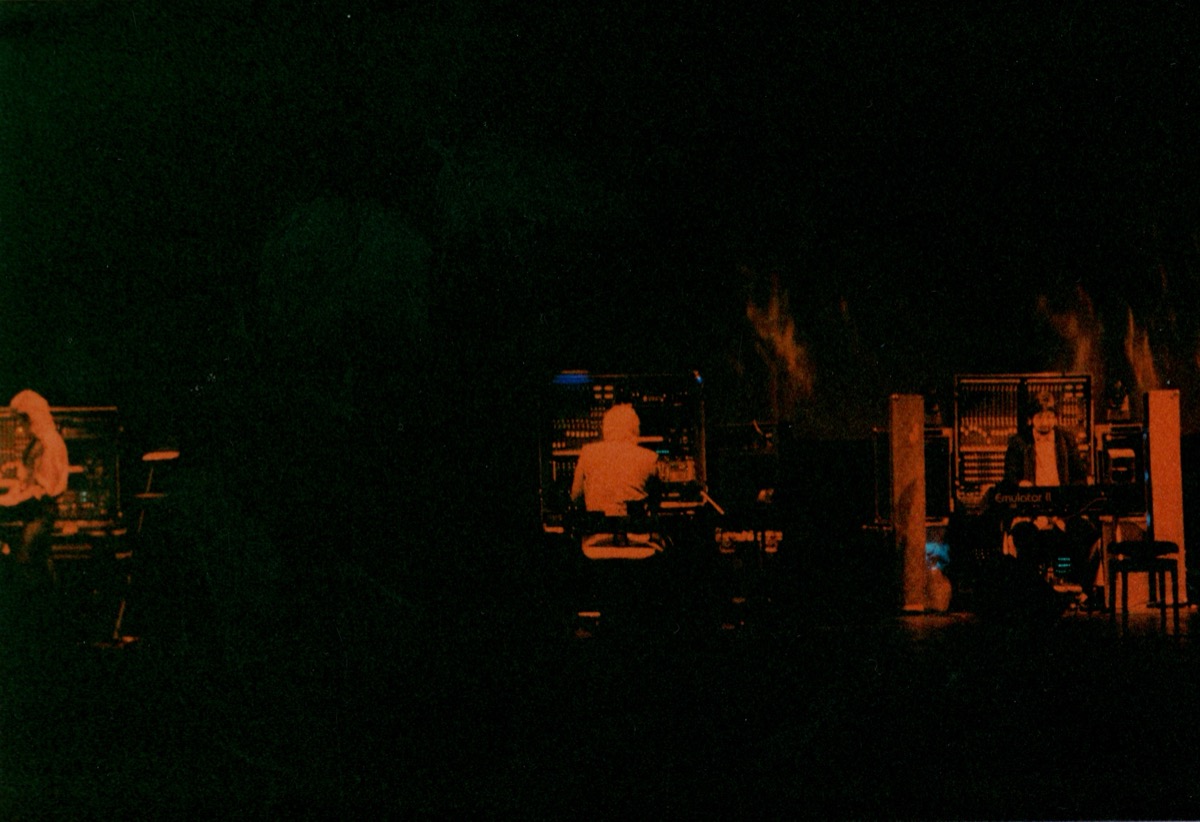
Tangerine Dream in the 1980s. Edgar Froese's kosmische voyagers stretched synthesizers into vast, cinematic landscapes that soundtracked a generation of films.
Klaus Dinger and Michael Rother left Kraftwerk in 1971 to form Neu!, inventing the motorik beat—Dinger's relentless quarter-note kick drum pattern—that would define krautrock's rhythmic DNA. They recorded three albums with Conny Plank between 1972 and 1975 before creative tensions split them. Dinger's confrontational perfectionism clashed with Rother's more atmospheric sensibility. Edgar Froese led Tangerine Dream through constant personnel changes, the only constant in a project that began as psychedelic rock and mutated into sequencer-driven space music. Christopher Franke and Peter Baumann joined for the Virgin Records years, the period that defined the band's sound and commercial success.
Defining the Sound
Krautrock doesn't have a sound so much as an approach to sound. What unified these bands wasn't instrumentation or tempo, but a shared rejection of rock's received forms—the blues scale, the verse-chorus-verse, the guitar solo as emotional climax. Listen to Tangerine Dream's Phaedra and you hear sequenced Moog synthesizers drifting in and out of tune as the studio heated up, recorder flutes processed through echo units, and Mellotron strings creating long ambient washes. The accident that created the title track—tape rolling while they tested a new Moog—became the composition because they recognized that the equipment's instability, the way temperature caused oscillators to waver and detune, generated textures more interesting than precision. This was icy Germanic detachment meeting American psychedelia's expansiveness, except the Germans built their own tools.
The motorik beat that defined Neu! and later appeared in Kraftwerk's “Autobahn” was deceptively simple: a kick drum on every quarter note, minimal hi-hat on the offbeats, usually no snare, creating relentless forward propulsion that never builds or releases tension in the conventional rock sense. It's hypnotic without being numbing, suggesting motion—specifically the motion of driving at constant speed on the Autobahn at night, white lines disappearing under headlights. Klaus Dinger hit each beat with metronomic consistency but somehow without sounding mechanical; the groove lived in the spaces between the drums and bass.
The band would improvise for hours, Czukay keeping tape rolling continuously, then he'd spend days editing the raw material into coherent pieces.
Can's approach was different: jazz-trained drummer Jaki Liebezeit locked into minimal, repetitive patterns while Holger Czukay's bass and Michael Karoli's guitar wove complementary cycles on top. The band would improvise for hours, Czukay keeping tape rolling continuously, then he'd spend days editing the raw material into coherent pieces. Hours of playing reduced to minutes of composed music. Vocals—whether Malcolm Mooney's unhinged intensity or Damo Suzuki's glossolalia—functioned as another instrument, language stripped of meaning and treated as pure texture.
Kraftwerk's sound evolved from organ-and-flute free improvisation on their 1970 debut toward pure electronic synthesis by Autobahn. “We spend a month on the sound and five minutes on the chord changes,” they told an interviewer in 1981, revealing their priorities. The Kling Klang studio itself became their primary instrument. Hütter and Schneider spent years custom-building equipment, refining tones, creating what Hütter called “industrial German sound.” Vocoders processed voices into robotic textures. Drum machines and sequencers provided mechanical precision. But the paradox was that creating this illusion of effortless machine precision required enormous human effort—hours of programming, constant equipment maintenance, obsessive refinement of timbres. “The more we developed, the more the robots developed in ourselves,” Wolfgang Flür observed, describing how the man-machine concept consumed the men who created it.
Stories
In early 1975, Kraftwerk faced a logistical nightmare: they'd been invited to tour America to promote Autobahn, which had unexpectedly hit number 5 on the Billboard chart, but they had no idea how to perform their meticulously studio-crafted music live. Ralf Hütter and Florian Schneider had spent years building their Kling Klang Studio into a complex instrument, and now they needed to put it in flight cases. Wolfgang Flür, who joined in 1974, recalled the chaos: “The first shows were chaotic—equipment failures, timing issues, the stress of performing live after years of studio isolation.” With financial backing from Phonogram, they invested in duplicating their setup for the road, but the real breakthrough came from necessity: they had to simplify. The tours of 1975 established the classic quartet lineup with Flür on homemade electronic percussion—sensor pads hit with metal sticks to complete circuits triggering analog sounds—and new recruit Karl Bartos on vibraphone and more electronic percussion. “Wolfgang Flür's homemade electronic percussion, sensor pads that triggered analog sounds when hit with metal sticks, sometimes wouldn't work at all,” Flür admitted. For the first time, Hütter and Schneider sang live, processing their voices through vocoders. The tour transformed them from studio hermits into a functioning live act, though they'd always struggle with the contradiction between their robotic image and the very human sweat required to perform.
Can's recording of “Mother Sky” in 1970 captures their method at its most pure. Malcolm Mooney had just left the band, checking himself into a psychiatric hospital after his mental state deteriorated during recording sessions. The remaining quartet—Czukay, Schmidt, Karoli, and Liebezeit—were joined by Damo Suzuki, whom they'd literally met on the street that day in Munich. They spotted the young Japanese man busking, singing in a style that seemed to come from everywhere and nowhere at once. His name was Kenji Suzuki, though everyone called him Damo. The conversation was brief: would he like to perform with them that night? He said yes. They brought him directly to soundcheck with no rehearsal. That evening, Suzuki sang with Can for the first time, and within days they were in the studio recording “Mother Sky”—twenty-three minutes of improvisation captured essentially as it happened, Suzuki's wordless vocalizations floating over the band's locked groove. No overdubs. No second takes. The instant composition method in its purest form. Czukay kept the tape rolling and later edited the performance into the final piece, but the core recording was one continuous take, the sound of five musicians achieving telepathic synchronization in real time.
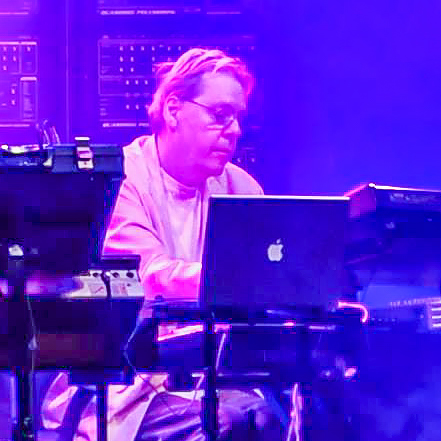
Klaus Schulze. From Tangerine Dream's first drummer to solo synthesizer pioneer, Schulze's epic electronic compositions mapped inner space.
Tangerine Dream's most famous track came into existence because someone forgot to turn off the tape machine. In 1973, the band was experimenting with their newly acquired Moog synthesizer at their Berlin studio, getting familiar with its temperamental nature. Edgar Froese, Christopher Franke, and Peter Baumann were just testing sounds, letting the sequencer run through patterns, adding recorder and Mellotron on top. The tape happened to be rolling. When they played it back later, they realized they'd accidentally created something more interesting than anything they'd planned—the drift in tuning as the analog oscillators warmed up and responded to room temperature created an eerie, organic quality that perfectly matched their aesthetic. They kept the take as it was, temperature drift and all, added some additional performances over it, and titled it 'Phaedra.' The track became the title of their Virgin Records debut, reached number 15 in the UK charts, and established the kosmische musik template that would define ambient and new-age music for the next decade.
By the late 1970s, Kraftwerk had become so committed to their man-machine aesthetic that they began sending robot mannequins to photo shoots and interviews in their place. The life-size replicas, built to resemble the four band members, would stand on stage during parts of performances or pose for photographers while Ralf Hütter, Florian Schneider, Wolfgang Flür, and Karl Bartos remained hidden. Karl Bartos recalled the visual impact: “We were all alike. No one was very short, no one was a giant. It never happened, but we could all have exchanged clothes. Everywhere we went, we received a very strong reaction and knew that a certain identity was coming across.” All four members stood exactly 6 feet tall, creating a uniformity that reinforced the robotic image. This wasn't just gimmickry—it was Kraftwerk taking their conceptual project to its logical conclusion. If they were making music about technology replacing humanity, why shouldn't technology replace the musicians themselves? The mannequins became famous enough that they were displayed at museums, and fans would sometimes show up expecting to meet the robots rather than the men. The irony, which Hütter and Schneider were fully aware of, was that creating and maintaining this illusion of effortless machine precision required enormous human effort—hours of programming, constant equipment maintenance, obsessive refinement of every detail.
The conversation was brief: would he like to perform with them that night?
Can's recording process reversed the normal sequence of how rock albums were made. Instead of writing songs, rehearsing them, then capturing performances, they walked into their converted cinema studio in Cologne and simply played—for hours, sometimes days. Holger Czukay kept the tape rolling continuously, capturing everything. Jaki Liebezeit would lock into a groove, Czukay and Michael Karoli would find complementary patterns, Irmin Schmidt would add keyboards, and if they had a vocalist, he'd improvise over the top. Only after these marathon sessions would Czukay begin the real work: editing. He'd listen back to dozens of hours of tape, marking the sections where the music 'clicked,' where the four (or five) musicians achieved the telepathic sync they called 'instant composition.' Then he'd physically cut the tape with a razor blade—the same technique Hütter described Kraftwerk using—splicing together minutes from different takes, sometimes just seconds, constructing a coherent piece from the raw material of improvisation. The technique, learned from his studies with Stockhausen, allowed Can to capture the energy of live improvisation while shaping it into composed structures. What sounded spontaneous on record was actually the result of meticulous post-production, Czukay acting as both player and editor, finding the moments of magic buried in hours of exploration.
Legacy and Influence
Krautrock's influence on post-punk is so pervasive it's almost invisible—the DNA is there even when the bands don't acknowledge it. Joy Division's Stephen Morris has explicitly cited Klaus Dinger's drumming as formative, and you can hear the motorik beat ghosting through “She's Lost Control” and “Transmission.” Public Image Ltd's Metal Box, with its dubbed-out bass and Jah Wobble's minimal, repetitive lines, comes directly from Can's approach to rhythm as hypnotic foundation. The Fall's Mark E. Smith named a track “I Am Damo Suzuki” and covered Can's “I Want More,” while Wire's minimalist song structures and Siouxsie and the Banshees' atmospheric guitar work both owe debts to the Germans' rejection of conventional rock dynamics. The post-punk generation heard in krautrock a way to make rock music that wasn't blues-based, wasn't American, could be intellectual without being pretentious, visceral without being macho.
The connection to electronic dance music is even more direct. When Afrika Bambaataa interpolated Kraftwerk's “Trans-Europe Express” and “Numbers” into “Planet Rock” in 1982, he created electro and helped birth hip-hop as an electronic form. Wolfgang Flür observed the proliferation: “Oh it's everywhere. It's like you go into the forest and you see all the little mushrooms coming out everywhere. Everywhere in the world it sounds like Kraftwerk music.” Detroit techno's founding fathers—Juan Atkins, Derrick May, Kevin Saunderson—have all cited Kraftwerk as foundational, fusing the motorik rhythm and synthetic textures with funk's body knowledge. Kraftwerk's “Autobahn” and Can's grooves showed that electronic music could make people move without imitating disco.
It's like you go into the forest and you see all the little mushrooms coming out everywhere.
Meanwhile, Tangerine Dream's sequencer-driven ambient pieces created the template for new-age music, their Phaedra and Rubycon albums establishing the aesthetic of long-form electronic drift that would be endlessly replicated. Brian Eno collaborated with Cluster (and later Harmonia, the collaboration between Michael Rother and Cluster's Dieter Moebius and Hans-Joachim Roedelius), absorbing their approach to ambient electronic music and feeding it into his own Ambient series. The influence loops back on itself: Kraftwerk now play museums and galleries, their music recognized as art rather than just pop. “We all met at improvisational courses that were run at the university,” Ralf Hütter said, tracing the origin back to academic experimentation. What started as students trying to establish “some form of industrial German sound” became the foundation for most electronic music made since. Flür wasn't exaggerating when he suggested Kraftwerk might be more influential than the Beatles. “It was never 'John Lennon And The Beatles' or 'Paul McCartney And The Beatles',” Karl Bartos observed. “The Beatles were always 'The Fab Four', a proper band. Kraftwerk had that equality, too, in how we looked. We were the perfect band.” That equality, that uniformity, that man-machine aesthetic—it's still echoing through pop culture fifty years later.
Kraftwerk's synthetic textures and motorik rhythms directly inspired Juan Atkins, Derrick May, and Kevin Saunderson to create techno by fusing German electronic music with Detroit funk.
Post-Punk
Neu!'s motorik beat and Can's improvised grooves heavily influenced Joy Division, Public Image Ltd, Wire, and the Fall, providing template for rock music without blues-rock foundations.
Hip-Hop/Electro
Afrika Bambaataa's 'Planet Rock' sampled Kraftwerk's 'Trans-Europe Express' and 'Numbers,' creating electro-funk and establishing synthesizers in hip-hop production.
Ambient Music
Tangerine Dream's long-form sequencer pieces and Cluster's minimalism provided blueprint for ambient music; Brian Eno collaborated with Cluster and absorbed their studio techniques.
New Wave/Synth-pop
Kraftwerk's melodic electronic pop directly influenced Gary Numan, Ultravox, Depeche Mode, Human League, and OMD, establishing synthesizers as mainstream pop instruments in the 1980s.