The lobby
Derrick May’s mother left for work at 7:30 every morning and would not let him drive her car. The Electrifying Mojo, the Detroit radio DJ whose show ran through the small hours, ate breakfast at a restaurant a few miles from the house at around 5:30. So for months May took the car, waited in the restaurant for an hour and drove it home before she noticed it had moved. “I actually stole my mother’s car every morning,” he said in 2006. He had a record to give Mojo.
The record was Cybotron’s first single, “Alleys of Your Mind”, made by his friend Juan Atkins and a Vietnam veteran called Rik Davis, and released on their own Deep Space label. May was not in the group. “Juan wouldn’t let me touch the keyboard,” he said. “I was his promoter and I was his cheerleader.” One morning Mojo turned up. The owners told him the kid had been coming in for months looking for him, and May handed over the record at half past six. Mojo said thanks, and May heard nothing for three or four days. Then a call came to go down to the station. “He made us sit in the lobby of the radio station and he played the record and that changed our lives,” May said. “I mean really. That one moment changed our lives.” May has told it other ways, and Atkins remembered playing Mojo a tape in his office, instead.
Mojo had been on the air since April 1977, first on WGPR, for five hours a night with no format to keep to. He would open with the theme from Close Encounters, play some Jimi Hendrix and run into Funkadelic, and May and his friends learned much of their music from him. “The first place I heard Kraftwerk was on his show, in ‘78 or ‘79,” Atkins said. “We would listen to him religiously every night.”
Atkins, May and Kevin Saunderson had met as boys in Belleville, a small town outside Detroit, where their families had moved. May called it “a farm town” of about 5,000 people, where there were perhaps eight students of color in the school, “so we kind of became friends”. May and Saunderson came together through sport. Atkins talked about the future. “He had this vision, he was like, ‘Man, I’m all about the future’,” Saunderson said. “I was like, ‘What’s this motherfucker talking about, he all about the future?’”
“Alleys of Your Mind” came out in 1981, and Atkins reckoned it sold between 7,000 and 10,000 copies in Detroit alone. In early 1985 he started his own label, Metroplex, and its first record, “No UFO’s”, which he made as Model 500, sold between 10,000 and 15,000. He had expected only to make his money back. Some who bought his records had no idea where they came from. “I had people come up to me and say they thought Cybotron was some white guys from Europe,” Atkins said.
Two rooms in Chicago
Chicago was a five-hour drive away. When it came to the imported dance records Chicago’s DJs played, “Detroit was a hick town compared to Chicago,” Atkins said. May’s mother moved there when he was in his last years of high school, and he went to visit her by train. The first thing he heard on the radio, at midday, was “Feel the Drive”, a record he had never heard before. In the record shops people told him only that Frankie or Ronnie was playing a record, and that was enough to sell it. “Who is Ronnie? Who is Frankie?” May wondered, until the staff told him where to go.
He went alone to the Power Plant, where Knuckles played. It cost $15 to get in. “It lifted me off my feet – I was elevated,” May said. He remembered the smell, the long stairway up, a lofty room painted black and a sound system nobody could see, because it seemed to be everywhere, with Knuckles in a booth “just high enough where you couldn’t touch him”. Some weeks or months later he went to hear Hardy at the Music Box. That room was about 18 feet wide and very long, and the DJ booth was “just a hole in the wall in the middle”, almost at floor level. The crowd was younger, from the South Side, and more physical. “When I finally went to hear him, I wasn’t elevated, this time I was flat-out busted down!” May said. Hardy played Stevie Wonder’s “As” 8 percent fast, and added drums and effects to keep the dramatic part going round again. May took his shirt off and danced with the kids every week. “Frankie was my man. I loved him, he lifted me off the ground, he set me up for life, but it was Ronnie that moved me to the ultimate level of knowing I could do this shit,” he said.
He got to know Knuckles well enough to sit in the booth and even play for a couple of minutes. At some point he owned two Roland TR-909 drum machines, one more than he needed, and nobody in Chicago had one. He needed money. “Juan said, ‘Don’t do it,’” May remembered. He drove the spare to Chicago, offered it to Knuckles, and Knuckles’s right-hand man Craig Loftis fetched the cash. Atkins told him, “Man, that was the biggest mistake you ever made.” Knuckles told the story in 2011 with a different ending. “Derrick May gave me my first drum machine, which is a 909, and I’ve been in love with that drum machine ever since.”
The laundry basket
Then May shut himself away. He had cut himself off from Atkins and could not pay the rent on his one-bedroom apartment, but he had equipment. “I just ended up spending the next year of my life hibernating, working with the equipment every single day until I developed this thing,” he said. “I didn’t turn on the radio on purpose. I didn’t turn on Mojo at all. I didn’t turn on the TV. I barely even wore clothes. I ate nothing but cereal.” He made two or three hundred pieces of music and put them all on cassette. “I had this basket, the sort that most people would put dirty clothes in, and it was all cassettes. To the brim.” In it were the first versions of “Nude Photo” and “Strings of Life”.
The orchestra on “Strings of Life” came from further back. His mother had connections in Detroit’s music community, and May said in 2006 that as a boy he had been able to record progressions at the local orchestra hall onto cassette. (A 1990 profile dates his Orchestra Hall strings from a later track, “It Is What It Is”.) He kept the tapes for years, loaded the sounds into an old Ensoniq Mirage and played the string parts on its keyboard. When he had the orchestration and nothing else, no drums and no piano, the track frightened him. “I listened to it for 24 hours. I slept to it and woke up to it, because I hadn’t finished it,” he said. “It freaked me out, so I couldn’t finish it.”
He put out “Nude Photo” first, in 1987, on his own label, Transmat, which he had started with $300. “‘Nude Photo’ opened the door,” he said. “‘Strings of Life’ could have been obliterated if it had come out the wrong way.” May played some of the piano on “Strings”, and the rest was an accident. His friend Mike James had recorded some piano a year earlier for a ballad of his own, and May came across a piece of it, chopped it and looped it over the strings. He took the editing to Jay Dixon, a friend who was a radio production manager and had taught him to cut tape backwards. “We sat down with ‘Strings of Life’ and he did the edits. And boy did he do the edits! Those edits were perfect,” May said. “That’s why I never want to remix it.”
The finished record had no bassline. May said Mike Dunn had no idea how people could accept a record without one. “It had never dawned on me that ‘Strings’ didn’t have a bassline,” May said. It went straight to cassette, he said in 2004, and he never mastered it to another format. Neil Rushton, the Englishman who later licensed May’s records, remembered it was “Nude Photo” that was done straight onto cassette, “and that was the master”.
He was asked in 1988 what it was about. “‘Strings’ was about Martin Luther King,” he told the NME. “When they killed him, they destroyed the hopes and dreams of a generation. It was about the hope in this message.” Saunderson, interviewed in London the same year, gave another reason. “He made that out of frustration with Detroit and the way people are acting. I know Detroit is the last place he wants to be; he doesn’t care to be there at all,” he said. “There aren’t any lyrics to say what he feels, but I think the way he did the track is his way of saying it.”
Trunks full of records
May’s first ambition for the two records was simple. “With ‘Nude Photo’ and ‘Strings of Life’, my first ambition was to take them to Chicago, then to get Ron Hardy and Frankie to play them,” he said. “I thought if those guys played my record, I’d made it.” It was harder than it sounded. George Baker, a Detroit friend who drove to Chicago with him, remembered May “just being distraught” when he went there and didn’t hear his music played. He gave “Nude Photo” to another friend, Alton Miller, to take to Chicago. Miller called him from there. “Man you’re not gonna believe this!” May remembered him saying. “Ron Hardy played your records four times in a row!”
After that the records sold. When they started out, May said, they sold between 3,000 and 5,000 records a week. Every weekend they loaded the trunks of two cars, Saunderson’s and a friend’s, since May still had no car of his own, and drove the records to Chicago’s shops, Imports Etc. among them. The shops paid cash on delivery. “Come back with 10 grand, turn it over, we would order more records, and then process making more records,” he said. Saunderson found the city easy to work. “Chicago was easy. You just gave your stuff to all the Hot Mix people and they played them,” he said, meaning the Hot Mix 5 DJs on the radio there.
In Detroit a record shop, Buy Right, could sell 700 or 800 a week, but the radio gave the new records little help. “In Detroit, it was played mainly in clubs because there was no radio,” Atkins said. May remembered it differently, with “Nude Photo” on daytime FM. Saunderson had worked in Detroit radio himself. “The radio station told me I was ahead of my time and then fired me,” he said.
A call from Birmingham
Neil Rushton had promoted northern soul all-dayers in the Midlands and at the Blackpool Mecca in the 1970s, and he was a reporter on a newspaper when house music reached Britain. By 1987 he had a small label in Birmingham, Kool Kat, named after a Detroit soul record. The Chicago records were already sewn up by bigger labels. “I’d always been into Detroit records because of the Northern Soul thing,” he said, “so when the imports started coming in on Transmat, KMS and Metroplex I was interested.” He called the number printed on a Transmat record, “Nude Photo” he thought, just before “Strings of Life” came out.
May could barely follow him. “I couldn’t understand Neil, because he has that strong Brummie accent and he runs over his words,” he said. Rushton wanted to bring him to England to meet people. Then he called back to say he could not pay for the ticket. May asked around. “My mother said, ‘Pay for it.’ Kevin Saunderson said, ‘Pay for it.’ Juan said, ‘Don’t do it.’” He paid, flew over and took a bus from the airport to Birmingham, where Rushton put him in a small bed-and-breakfast, the first hotel he had stayed in without his mother. He called her to say he had arrived and talked for about 20 minutes. “The next day when I checked out I got the bill: it was £200 for the phone call. Welcome to England!”
Rushton took him around the record companies with a cassette of his tracks. At EMI they sat in an executive’s office. “He put on ‘Strings of Life’,” May said. “He says, ‘Let the music talk for itself.’ The guy then gets on the phone and turns the other way,” May said. “The song ends and he’s still talking on the phone. Finally he says, ‘Nice to see you,’ and that’s it.” It went the same way in meeting after meeting. “Lots of people had the opportunity to take ‘Strings of Life’, but nobody wanted it. Nobody.” The only company even partly interested was Zomba, and only in a publishing deal, without putting any of the songs out.
“Strings of Life” came out in Britain in February 1988 on Jack Trax, through a deal May made with Damon D’Cruz there, on a six-track 12-inch shared with Model 500. Music Week gave it one line in its dance reviews, calling it “jaggedly flying exciting if specialist house instrumentals”. In April 1988 Transmat made Rushton its agent in the UK. He was clear afterwards about how little the British noticed at first. “‘Strings of Life’ was an underground record originally,” he said. “Damon sold copies of it, but it certainly wasn’t regarded as house music’s answer to ‘Sex Machine’, it was just a great record.”
Naming it
Rushton had a bigger idea. The Detroit records sounded so different from Chicago’s that he wanted to put a wave of them on one album, and he asked Mick Clark at Virgin to pay for it. Virgin’s 10 Records agreed, and in 1988 Rushton flew to Detroit with two journalists: Stuart Cosgrove, who was writing for The Face, and John McCready of the NME. It was the first time he met Atkins or Saunderson.
The working title was The House Sound of Detroit, or something close to it. Nobody remembers it quite the same way. “At the time, everything was house, house house,” Rushton said in 1993. “We thought of Motor City House Music, that kind of thing, but Derrick, Kevin, and Juan kept on using the word techno.” Cosgrove asked Atkins what he called the music, and, May said, Atkins answered that it was techno. May hated the word. To him techno was a style coming out of Miami that he wanted nothing to do with, and he begged Atkins for a year not to use it. He would have preferred “high tech soul”. “Juan said, ‘We call it techno.’ I said, ‘I don’t say that,’” May remembered. “Nah man, this is techno,” Atkins told him.
Rushton, who had spent his youth hunting for obscure Detroit soul, saw the old city everywhere. The records were pressed at Archer’s, and “the guy there was the son of the guy who used to do all the independent Northern Soul classics”, he said. The three talked about the future, and Rushton was a little skeptical of it. “I think that Derrick was very articulate and was quick to see what people wanted,” he said.
At three one morning McCready rode with May through the empty streets. “This place is fucked, man. It’s finished,” May said, driving past a gutted building with holes where the windows had been. He took McCready to his old apartment on Second Avenue, where he had made his tracks, and described the view from the top-floor window. “I would work through the night and I would see the city waking up – the face without the make up. At night you would see the heat rising in the air from the stacks of old factory buildings.”
For the album’s sleeve notes Cosgrove quoted Atkins on the city’s most famous music. “Berry Gordy built the Motown sound on the same principle as the conveyor belt at the Ford plant,” Atkins said. “Today the automobile plants use robots and computers to make their cars and I’m more interested in Ford’s robots than Gordy’s music.”
Saunderson found the attention baffling. “I wasn’t used to being interviewed, especially by people talking about our music,” he said. “I’m thinking, ‘Why you want to know that? Why is this important to you?’” The Face was going to put them on its cover, May said, and at the last minute gave it to the singer Yazz. “That pissed us off,” he said.
The album needed one more track. Saunderson had a song for his group Inner City, sung by Paris Grey, that May did not like and did not want on the record. Rushton, Saunderson said, “was like ‘We need one more track’.” “That’s how that ended up happening, because ‘Big Fun’ was not going to be on that album.” The album, Techno! The New Dance Sound of Detroit, came out in the summer of 1988. By 16 July Music Week was writing that Detroit artists were “producing what they call techno music”.
Suits on the dancefloor
Months before the album, early in 1988, the first British tour, with May, Saunderson and Blake Baxter, went badly. “On some of the dates we went,” May said, “people were wearing suits. Some people sat down on the dancefloor, wouldn’t dance.” Saunderson remembered playing what felt to them like pop clubs. The places that seemed right were a few parties in London and the Haçienda in Manchester, which they went to see, though they did not play there. While the album was being made, the Detroit records were slow to catch on even at Spectrum, the London acid house night on Mondays. “When we did that album, I’d go down to Spectrum every Monday and they wouldn’t play the records we were bringing along,” Rushton said. “If you heard two Detroit records in a six-hour session, then that was it.” The DJs who knew the music best were in Manchester, he said, “the Haçienda with Mike Pickering and Graeme Park, who knew every record on Metroplex, Transmat and KMS”.
By the summer it had turned. Saunderson first heard his own record played in a British club at Spectrum, when Oakenfold put on “Big Fun” one Monday. “It was unreal. It was the summer of 1988,” he said. On the dancefloors he found something he had not seen at home. “First off, I didn’t realise white people could dance! I didn’t have nothing against white people, but in America white people didn’t dance.” May came back some months after the first tour. “We came back about six months later, and that’s when we saw people – ‘acieeed!’”
“Big Fun” entered the British singles chart on 3 September 1988 and reached No 8. “Good Life” entered in December and reached No 4. The compilation did not recoup what Virgin spent on it. In London it reached two young black DJs, Grooverider and Fabio, who had been listening to Chicago records. “I know exactly what caught me, the double compilation album ‘Techno! The New Dance Sound of Detroit’,” Grooverider said, years later, in conversation with Saunderson. Fabio thought it was Reese & Santonio’s “The Sound” that first caught him. “It sounded Black to me, it sounded like Black music, because it had the funk,” he said.
Back in Detroit, the radio took notice at last. Music Technology reported in September 1988 that the city’s stations had played no techno until five months earlier, which Saunderson put down to jealousy among DJs, and that “Big Fun” was now the biggest song in Detroit, on the radio four or five times a day. “When you start to get known in the UK, America pays attention to you,” he said. Asked years later how it felt when Europe picked it up first, Saunderson said, “I just figured, ‘Hey, y’all motherfuckers will catch up eventually.’” May, asked how it felt to see his music selling mostly in Europe, said, “It made me angry and pissed off.” “When we put out our first records, we sold thousands in the States.”
“Strings of Life” never made the British top 75 in its original form. Its fame came through the clubs, and then the big outdoor raves. “It was revived when the outdoor raves came,” Rushton said. “I did it on one keyboard, then recorded it on cassette,” May said in an interview in the late 1990s. “The damn thing has sold over a 100,000 copies!” Europe also changed the business that had kept Transmat going. “We actually stopped making money once we started dealing with Europe,” he said. “That’s when it all kind of went pear-shaped.”
A room of their own
Detroit got a club of its own in 1988, opened by three of May’s friends. George Baker, Alton Miller and Anthony Pearson, who DJed as Chez Damier, had made regular trips to Chicago together, to the Music Box and the Power Plant. “Once I heard Larry Levan, once I heard Ron Hardy and Frankie Knuckles,” Baker said, “anything that Detroit could offer us was incomplete, unsatisfactory.” They took a four-story former shoe store at 1315 Broadway, downtown, and sanded the floors and built the toilet stalls themselves. Miller said he had seen tumbleweed blow down Broadway. “I didn’t realize Detroit was such a ghost town,” Saunderson said. “I had to drive out to the suburbs to get groceries.”
The Music Institute opened in May 1988, and the police shut the opening night. Saunderson played it, all night, because May was in Europe. After a few weeks the Friday nights, called the Next Generation, were May’s, with Darryl Wynn warming up from midnight to three. There was a juice bar and no alcohol. The man who installed the sound system said only that it was “a small room, so it was loud”. The lights were a fog machine at one end and a strobe at the other. Members had black, gold or platinum cards and a line of their own. May said membership cost $200, and the door $25. When Depeche Mode were brought to the bar in 1989 and discovered there was nothing to drink, Martin Gore said, “Waters all round.”
Sierra Donaven lived above Miller’s apartment and had come down in her rollers to complain about the noise. He offered her a membership. She was a special agent for the US Treasury, and nobody at work knew she loved to dance. “From the day they opened the doors, I was there, every single night,” she said. One night May played Lil Louis’s “French Kiss”, a white label only a few Chicago DJs had. “When it slowed down, people lost their fucking minds,” May said.
Accounts of who came, and how many, differ. May remembered a line around the corner. Jeff Mills, then a Detroit radio DJ known as the Wizard, remembered it “always half full”, and a place where people stood and listened to the new records May, Atkins and Saunderson brought back from Europe. “It was almost kind of almost like a workshop, in a sense,” he said. Carl Craig was one of the listeners. “The Music Institute was my music education,” he said. “It was the closest thing to having a Paradise Garage, or a Music Box, in Detroit.”
The DJs played for nothing for most of the first year. After that May had to fight the club’s manager for his fee. “I had to beg him for $400 a week to play,” he said. “400 bucks!” By then May was earning in Europe and missing Fridays. “All of a sudden I started getting offers to come play in Europe,” he said. “I got infatuated with England. I couldn’t leave.” Baker could see how it would end. “At the end of the day, we couldn’t pay the bills,” he said. “That’s why we closed.”
The last Friday was in November 1989. The flyer told the regulars to “pack this fucking box”. Neil Ollivierra, who designed it, remembered people crying when May played the records everyone knew. “You could see it in the strobe lights,” he said. In Ray Philp’s history of the club the last record was 808 State’s “Pacific State”. May remembered it as his own remix of “Sueño Latino”, out that week. It had lasted 18 months. The same month a remix called “Strings of Life ‘89” entered the British chart, and stayed two weeks, and got no higher than No 74. On 9 November, in Berlin, the wall came down.
Resistance
Mills had watched all of this. He had played in an industrial band, the Final Cut, and been through major-label deals that came to nothing. With Mike Banks, a session musician who lent him keyboards, he started talking about a label of their own. They looked at their elders first. Saunderson had just finished the second Inner City album. “We had heard that Virgin was kind of jerking him around, and they wanted him to mix much more commercial music and Juan [Atkins] was making much more commercial stuff too, and Derrick was trying to sing or something like that,” Mills said. “We thought that that was not the way to go, that the original idea of Detroit techno was being lost.”
They formed Underground Resistance in 1989 and put out its first records the following year. Unlike their elders, they did not license their records to everybody. Banks had heard the stories the older men brought home. “We couldn’t keep up with London,” he said. “London was vicious, man.” Mills had made up his mind before he had ever been to England. “Mike and I, we didn’t like UK. We didn’t like England,” he said. “Before we even went there we just didn’t like it... And also, what they were doing to Kevin, we didn’t like it. So we thought that Germany makes much more sense for us.”
He knew one person in Germany. Years earlier Dimitri Hegemann, who ran a label in West Berlin, had been in Chicago visiting Wax Trax!, the label that handled his records in America. The owner, Jim Nash, kept a bucket of tapes he had turned down. “Dimitri, take anything you want. We don’t take these,” Hegemann remembered him saying. Hegemann took one out and listened to it. On it was a phone number beginning 313. “I called it from Chicago and on the other line was Jeff Mills,” he said. The tape was Mills’s band, the Final Cut, and Hegemann put their album out on his label, Interfisch, in 1987 or 1988. “But I must also say nobody was interested in this music here.”
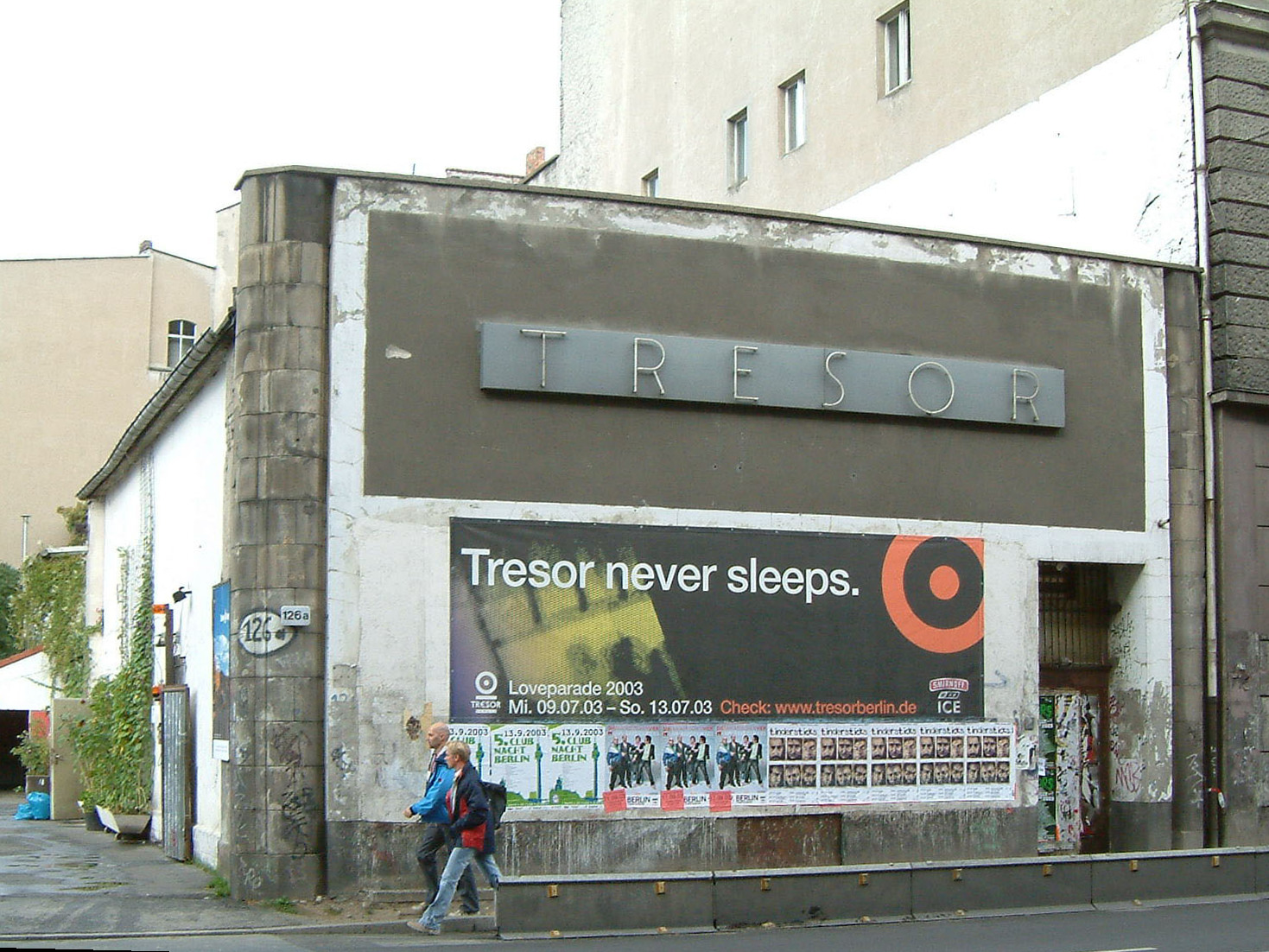
Then the wall came down, and for years afterwards, Hegemann said, “there was nobody who said, ‘You can’t do this.’” In March 1991 he opened a club called Tresor in the vaults of an old department store near Potsdamer Platz, in what had been East Berlin. Hegemann remembered bringing the Final Cut to play in Berlin in 1990, and the accounts differ on how Underground Resistance followed. In Mills’s telling, he picked up the phone. “So I called him and told him, ‘Do you remember me? My name is Jeff Mills from this group?’ And he said, ‘Yeah.’” Hegemann asked if Underground Resistance would like to come over and DJ.
Mills did not want to go alone, so he took Blake Baxter, who had been on the first British tour. “That was the first time that we had come to Germany, it was Blake and myself representing Underground Resistance,” he said. Back in Detroit he told Banks what he had seen, and the two of them came up with X-101, which they licensed to Tresor. Hegemann was starting a label to go with the club, and X-101 became its first release, Tresor 1.
Notes
Written from the sources below, with every quotation matched word for word against the interview or report it comes from, then checked claim by claim in separate reviews. Where witnesses disagree on a date, the piece says so. Drafted with AI assistance.
- Techno! The New Dance Sound of Detroit, sleeve notes by Stuart Cosgrove, 10 Records, 1988
- Release data for Transmat, Metroplex, Jack Trax and Tresor, Discogs
- Kevin Saunderson, Fabio and Grooverider in conversation, Mixmag, 2025
- Derrick May: The Secret of Techno, Mixmag, c. 1996
- The Techno Wave, Music Technology, September 1988
- Future Shock, Music Technology, December 1988
- Techno Rhythim, Music Technology, 1990
- Dance reviews and new releases, Music Week, 27 February 1988
- May's acid test, Music Week, 23 April 1988
- Solving the housing problem, Music Week, 16 July 1988
- Welcome To The Phuture, NME, 16 July 1988
- Inner City: singles chart history, Official Charts Company
- Rhythim Is Rhythim: singles chart history, Official Charts Company
- Derrick May: It Is What It Isn't (lecture), Red Bull Music Academy, 2006
- Mike Banks, Dimitri Hegemann and Carola Stoiber (lecture), Red Bull Music Academy, 2018
- Jeff Mills (lecture), Red Bull Music Academy, 1998
- Frankie Knuckles (lecture), Red Bull Music Academy, 2011
- Nightclubbing: The Music Institute, Red Bull Music Academy Daily, 2017
- Theater of the Mind: The Legacy of the Electrifying Mojo, Red Bull Music Academy Daily, 2015
- Rik Davis: Alleys Of His Mind, Red Bull Music Academy Daily, 2016
- Interview: Derrick May, Red Bull Music Academy Daily (DJhistory archive), 2017 (interview 2004)
- Interview: Juan Atkins, Red Bull Music Academy Daily (DJhistory archive), 2017 (interview 2010)
- Interview: Kevin Saunderson, Red Bull Music Academy Daily (DJhistory archive), 2017 (interview 2005)
- Interview: Neil Rushton, Red Bull Music Academy Daily (DJhistory archive), 2017 (interview 2000)
- 30 years of Tresor, The Guardian, 2021
- Machine Soul: A History of Techno, The Village Voice, 1993
- Derrick May interview, UK magazine interview, reproduced by Fantazia, c. 1997
- Techno! The New Dance Sound of Detroit, Wikipedia
- Tresor, Wikipedia